
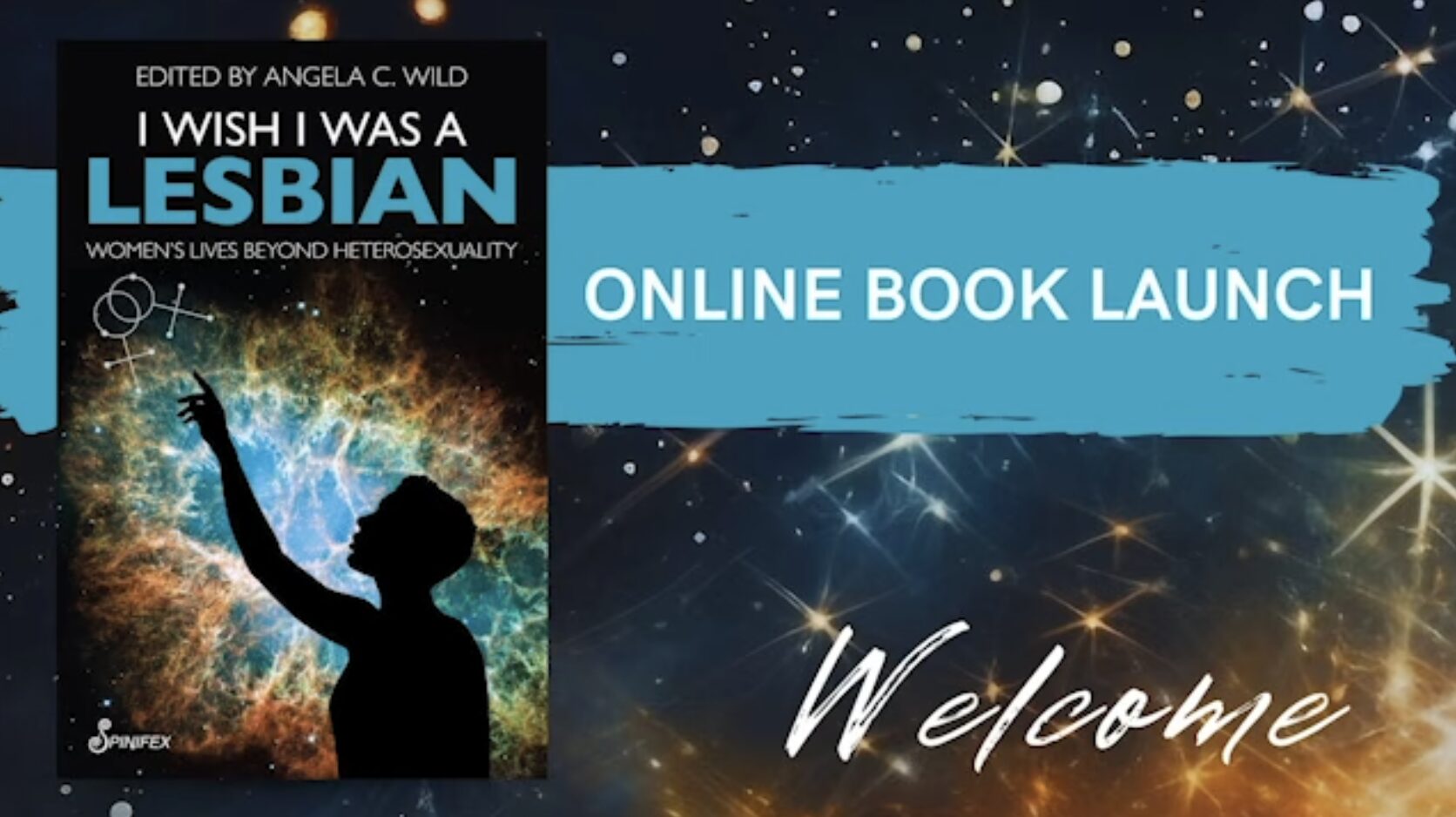
I Wish I Was a Lesbian – Spinifex Launch!
I started working on “I Wish I Was a Lesbian – Women’s Lives beyond Heterosexuality” at the end of 2024 when I contacted Renate Klein and Susan Hawthorne with a proposal they enthusiastically accepted!
The journey has been an amazing one, and I want to thank all the contributors and women who helped and encouraged me along the way!
The book is out (here), and this morning we had the official launch with Spinifex. A dream come true!
You can find the transcript of my talk below!
Enjoy!
Hello everyone, and thank you for being here.
Thank you, Bronwyn, for that lovely introduction. And thank you to Renate and Susan for giving me the opportunity to bring this work into the world. Thanks as well to the wonderful team at Spinifex, and of course to each and every contributor to the book.
I have about 15 minutes to talk to you about this project, and of course there is a lot I want to say!
At its core, this book challenges a widely accepted mainstream idea: that sexual orientation is innate and immutable.
As you are aware, this is not a position everyone agrees with. Some people find it controversial, even hateful. But that is precisely why a book like this is needed—because feminism itself is often called controversial and hateful.
As Andrea Dworkin once said:
“What is affirmed, without being questioned, is not known; it is ideology, not truth.”
So beyond agreement or disagreement, my aim is to inspire curiosity. I hope women—both here and beyond—will approach this book with an open mind and make up their own minds in the peace and quiet of their own reading time, away from the toxic noise of social media.
Why this book?
This book comes from two starting points.
The first is a question that has always puzzled me:
Why are we not, as a feminist movement, applying our considerable collective critical thinking skills to the aspect of patriarchy that affects us in the most intimate way—sexuality? Why such resistance to those who bring this analysis?
This book approaches sexuality as political. Its explicit aim is to re-politicise sexuality—and the timing matters.
We are living through a significant shift.
Consider this: by 2030, 35% of women are predicted to be single and childfree.
If we understand sexuality politically, we cannot fail to see this as a historical moment—one that not only challenges the centrality of heterosexuality and men in women’s lives, but also the ways heterosexuality shapes and controls us as a group.
And at the same time, many women are searching for alternatives, often in the dark.
This brings me to my second starting point.
For years, I kept seeing the same sentence appearing in social media comment sections, almost like a plea:
“I wish I was a lesbian.”
Implicit in this is the internalised belief that sexual orientation is innate—fixed—and this belief can hold women back from exploring alternatives they might otherwise consider.
As someone who has gone through that journey from heterosexuality to lesbianism, this question called for an answer.
This book offers an answer.
It says to women: yes—you can be a lesbian.
Who is this book for?
It is a book aimed at any woman:
Women who consider themselves straight but feel curious about why, and how patriarchy may have shaped or confined them within heterosexual relationships.
For women who want to deeply understand women’s oppression, and how compulsory heterosexuality operates.
For lesbians who want to reflect critically on the idea of being “born this way.”
And of course for all those who find themselves thinking:
“I wish I was a lesbian—but I can’t.”
My initial belief was simple: if an idea is good—and I believe political lesbianism is a very good idea—it will resonate with women everywhere, across ages, backgrounds, classes, and life experiences.
The result is a patchwork of personal stories, theory, political thought, poetry, and art. Conceived as an intersectional project, it brings together women from 15 countries—spanning cities and rural villages, from their 20s to their 70s, and a wide range of cultural and social contexts, with life experiences as varied as their paths to lesbianism.
Together, they respond to that statement:
“I wish I was a lesbian, but I can’t.”
Main themes of the book
Beyond a critique of “born this way,” the book explores a number of major themes.
Political lesbians are often dismissed as old-fashioned relics of the Second Wave.
But I want to express my gratitude to the women of that era who contributed to this volume—Sheila Jeffreys, Julie Bindel, Lynn Alderson, Lauren Levey, Anne Menasche, Renate Klein, and Susan Hawthorne.
They deserve genuine praise for publicly holding their positions for so long, despite relentless attacks. Their accounts recall a time when lesbian feminism flourished, when women choosing lesbianism was not controversial but part of a shared collective vision of liberation.
They remind us that another way for our movement is possible.
Patriarchy is understood throughout the book as a structuring force in women’s lives.
Renate Klein and Cris Walker describe how their previous heterosexual marriages revealed the ways men and heterosexual institutions restrict women’s lives, reducing them to “wives” or secondary actors—sometimes even in their own eyes.
This is a topic completely of our time, as the tradwife ideology—copied and pasted from the 1950s—is making a major return.
Yagmur Ougarkuzu’s contribution shows that this framing continues to shape the thinking of younger women today, including within the feminist movement.
Many contributors to this anthology are under 30, the youngest being just 21. Their work brings political lesbianism into a contemporary light and demonstrates its continued relevance to the oppression young women face today.
Realising their attraction to women, two young lesbians were initially tempted to identify as men.
In Charlie May’s account, the role of trans ideology as a strategy enforcing compulsory heterosexuality is explicit.
The sexual coercion of lesbians through the “cotton ceiling” by men who call themselves lesbians, the social pressure to identify as bisexual instead of lesbian, the internalised hatred of one’s female body—nowadays called dysphoria—and the traumatic, dissociating process of transition are all seen as strategies designed to gaslight women into believing they should include men in their sexual lives.
Trans ideology is seen as a new patriarchal assault on women’s rights, but also against lesbian existence.
There are clear links in several chapters between the imposition of heterosexuality and the imposition of femininity—through dress codes, makeup, and behaviour.
In that context, choosing lesbianism has allowed some of these women to assert themselves as full human beings while rejecting sexist stereotypes and objectification.
The damaging impact of heterosexuality also emerges in reflections on celebrity culture, where even famous women are diminished or harmed within their heterosexual relationships.
The book engages with the impact of visual culture, pornography, and the media, examining how they enforce compulsory heterosexuality and negatively influence young lesbians’ understanding of lesbianism.
Women in this anthology came to lesbianism at different stages of life: some very young, while others were late bloomers.
And for many, the journey was not linear. Coming out early, succumbing to compulsory heterosexuality after enduring intense anti-lesbian bullying, harassment, or violent family rejection, only to return later with a feminist consciousness, is not an uncommon path.
These trajectories are analysed also in Anne Menasche’s piece.
The book demonstrates how the core ideas of political lesbianism function across class and racial structures.
For example, working-class women have developed very pragmatic reasons for adopting political lesbianism as a positive strategy for survival under patriarchy. Jesika Gonzalez explains how women living together—as couples or as a collective—can provide a solution to the financial hardship women face under patriarchy.
The Mexican lesbo-feminist movement, described by Daniela Medina—but also represented by Tabata Spinster and Kenia Salas—developed independently from Western lesbian feminism an intersectional lesbian feminist theory inherently rooted in anti-racism, anti-classism, anti-capitalism, and anti-colonialism, as far removed as possible from any idea of single-issue feminism.
Fundamentally women-centred, it encompassed all the oppressions women face.
As we know, political lesbians are frequently placed in opposition to “real lesbians,” particularly gold-star lesbians.
In this framework, a “real lesbian” could not possibly agree with lesbian feminist theory or believe that women can choose lesbianism.
As we see in this book, this is not the case.
Several lifelong lesbian contributors—despite having minimal or no experience of heterosexuality—conclude that developing a political understanding of heterosexuality and lesbianism enriches their lives and their feminism.
Anne Ehrlich and Alima highlight the many dimensions of lesbian life beyond sexuality, particularly the capacity to connect with women on multiple levels.
Along the same lines, Sheila Jeffreys rejects the idea that lesbian should be defined solely as sexual behaviour. She argues that such a framing is patriarchal, reinstating early sexological policing of who counts as a lesbian and who doesn’t.
And that, she explains, is a strategy designed to limit our numbers, restrict women’s ability to disengage from heterosexuality, and weaken feminism.
Contributors explore lesbianism as a reconnection with the self—a realisation that women can exist as whole, self-defined beings.
Most contributors describe how their lives—and often their mental health—improved dramatically once they realised they could positively embrace lesbianism through choice, rather than as a negative deviant identity imposed by patriarchy.
The anthology addresses suicidal despair and alienation as the logical outcome of a system that erases female consciousness and denies lesbian possibility.
We hear about sexual trauma and male violence, and the book emphasises that emotional, political, and social liberation comes from women supporting one another, not from men.
For many, lesbian feminism is seen as the only framework that makes sense, explaining the oppressive forces shaping women’s lives while also suggesting a positive alternative that even radical feminism—with its focus on male violence—does not itself offer.
Political lesbians are often caricatured as bitter women who reject men, supposedly without any real desire or love for women.
While rejecting men is necessary to allow our love for women to blossom, passion and desire for women shine through the contributions in this book.
Many contributions explore themesmes around relearning our bodies, sexual fulfilment, clitoral knowledge, rejection of the male gaze, and the development of new aesthetics and ways of relating to one another.
The importance of the collective in enabling such shifts is a recurring theme throughout the book.
For example, the opportunity for collective living—the London squatting scene—or women-only gatherings such as the Mitch Fests, were and remain crucial for the building of second-wave radical thinking, and often pivotal for the women who experienced them.
Lesbian communities and women-only spaces are celebrated as collective spaces of political self-realisation—political lesbianism itself as a space for women’s creativity and liberation.
Indeed, the shift to political lesbianism has enabled life choices and creative potential that many of the women could never have imagined had they remained in heterosexuality.
The contributions demonstrate that political lesbianism is very far from obsolete.
On the contrary, contemporary political lesbianism remains vibrant, pertinent, and fiercely radical.
Its revolutionary potential has not diminished, as we can see in its capacity to inspire new generations of feminists.
It continues to challenge patriarchal structures and compulsory heterosexuality, and to imagine alternative ways for women to live, love, and organise collectively.
Conclusion
So to conclude, I would like to say this:
Ultimately, this book is not about telling women what to do.
Rather, it is an invitation to think beyond what we have been told never to question.
It about recognising that something we are told is purely personal—sexuality—is also deeply political, and requires a political response.
And it is about responding to that quiet but persistent sentence:
“I wish I was a lesbian—but I can’t.”
This book gathers voices that respond:
You can question.
You can think. In fact, you should.
And of course, you can choose.
And that possibility, in itself, is political and revolutionary.
Thank you.